
Templates / What Is an RFP Template?
Template guide
What is an RFP template?
It is a reusable starting structure for either issuing an RFP or answering one. This page focuses on the seller-side response template, gives you a copyable outline, and shows when a team should move from a document into a repeatable software workflow.
People usually mean one of two things
- • Buyer-side RFP template: the document used to issue a request for proposal
- • Seller-side response template: the document used to answer the RFP consistently
Start in the right place
If you need the buyer-side version, go to how to write an RFP. If you need the seller-side version your proposal team can use today, download the free RFP template or open the full response template walkthrough.
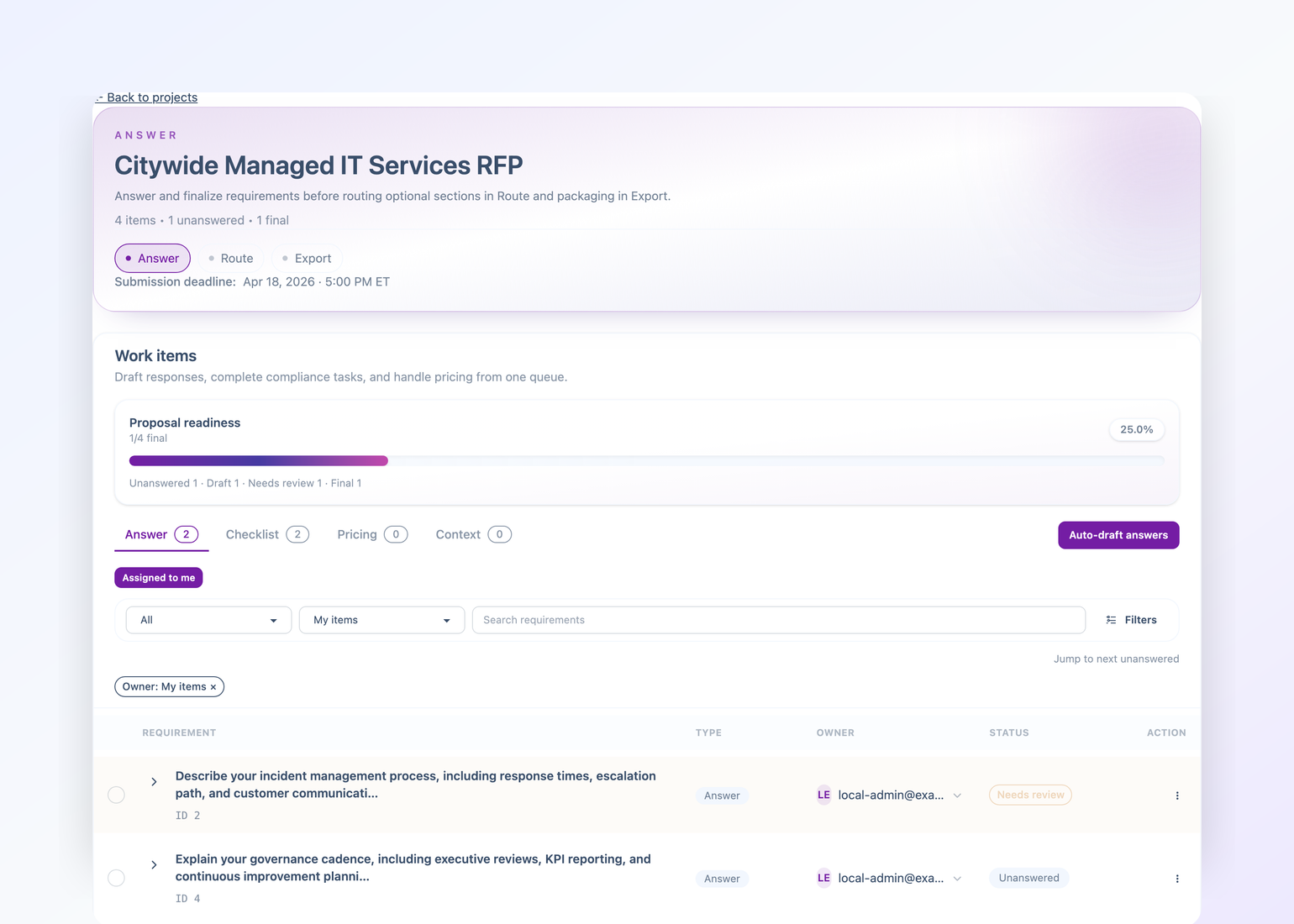
What is an RFP template in practical terms?
A template should remove blank-page friction without pretending static files solve the whole workflow.
An RFP template is a reusable starting document that helps a team organize repeatable sections instead of rebuilding the structure from scratch every time.
In practice, the phrase is ambiguous. Buyers use an RFP template to issue the request. Sellers use an RFP response template to answer it. Most teams searching this phrase want clarity on that difference first, then a practical structure they can copy or download immediately.
For lean proposal teams, the seller-side version is usually the more useful one: it gives you a repeatable place for the executive summary, requirements response table, delivery approach, proof points, and final review notes. That is the template this page supports.
If you want a ready file rather than just the explanation, go straight to the download-first template page. If you want a fuller walkthrough, examples, and guidance on tailoring it, continue to the RFP response template page.
Core sections
What a useful seller-side RFP template should include
These are the sections most lean proposal teams actually need when they want a reusable response structure.
Executive summary
Frame the buyer need, your fit, and the outcome you are proposing in plain language.
Requirements response table
Answer each requirement consistently with an owner, supporting source, and response status.
Delivery approach
Show timeline, staffing, governance, implementation logic, and review checkpoints.
Proof points and case studies
Bring in short evidence blocks that support claims without bloating the whole proposal.
Commercial and scope notes
Keep pricing assumptions, service boundaries, or packaging notes easy to tailor by opportunity.
Review and scoring layer
Track bid fit, owners, deadlines, and evaluator notes before the response goes final.
Copy a starter RFP response template outline
This page includes a usable asset even if you do not download the file yet.
Use this outline as the minimum viable structure for a seller-side RFP response. You can copy it into a document today, then replace the placeholders with buyer-specific content.
| Section | Purpose | What to include |
|---|---|---|
| Executive summary | Frame buyer fit quickly | Buyer goals, delivery confidence, differentiators, expected outcome |
| Requirements table | Answer each requirement clearly | Requirement, response summary, source content, owner, status |
| Delivery approach | Show how the work gets done | Timeline, staffing, governance, milestones, review plan |
| Proof and case studies | Support claims with evidence | Relevant experience, outcomes, references, short proof blocks |
Copyable example
Executive Summary

[Buyer name] needs a partner that can respond reliably, keep stakeholders aligned, and deliver the work without extra process overhead. [Your company] is a strong fit because we combine [core capability] with a practical delivery approach built for [buyer context].

For this engagement, we would focus on:
- [Outcome 1 tied to buyer goal]
- [Outcome 2 tied to delivery reliability]
- [Outcome 3 tied to speed, quality, or risk reduction]

Our team would deliver through [implementation approach], with clear owners, regular review points, and a structure that keeps the response aligned to your stated requirements.
When is a template enough, and when should you move into software?
Templates solve the starting-point problem. Software solves repeated reuse, review, and version-control pain.
Stay with a template when your team mainly needs structure, manages a lower volume of bids, and can still keep content and reviews under control in documents and spreadsheets.
Move into software when the same answers keep getting rebuilt, approved source content is scattered, and review cycles slow down because no one trusts the latest version.
Template is enough when...
- • You need a working response structure fast
- • Bid volume is still manageable manually
- • Review coordination is still light
Software is worth it when...
- • Repeated answers are spread across old files
- • Review and approval are slowing delivery
- • Stronger first drafts would save real proposal time
That next step usually starts with a cleaner proposal answer library and then the broader RFP response software workflow.
What Is an RFP Template? FAQs
Quick answers for teams that want the definition, the structure, and the next step.
What is an RFP template in simple terms?
An RFP template is a reusable starting document that helps a team structure either the buyer-side request for proposal itself or the seller-side response to that request.
What is the difference between a buyer-side and seller-side RFP template?
A buyer-side RFP template helps an organization issue a request for proposal, while a seller-side RFP response template helps a proposal team answer that request clearly and consistently.
What should a seller-side RFP response template include?
At minimum it should include an executive summary, requirements table, delivery approach, proof points or case studies, commercial notes when relevant, and a final review or scoring section.
When is a template enough and when do you need software?
A template is enough when the team mainly needs structure. Software becomes more useful when the real problem is repeated answer reuse, review coordination, and version control across many bids.
Start with a usable template, then upgrade the workflow when reuse becomes the real bottleneck.
This page explains the term, gives you a copyable outline, and routes you into the stronger download and workflow pages when you are ready.