
Templates / RFP Response Template
Template
Download a practical free RFP template your team can use today.
Get a free RFP response template plus a simple scoring matrix for lean proposal teams — then move into Winify AI when you need a reusable workflow instead of another one-off document.
What’s included
- • Word response template with recommended proposal sections
- • Excel scoring matrix for evaluating requirements and response quality
- • A filled example section on-page you can copy immediately
- • Guidance on when to move from static docs into a reusable workflow
Important: this is a response template
People use “free RFP template” to mean two different things. This page gives you the seller-side response template your team uses to answer an RFP. If you need the buyer-side document for issuing an RFP, start with how to write an RFP.
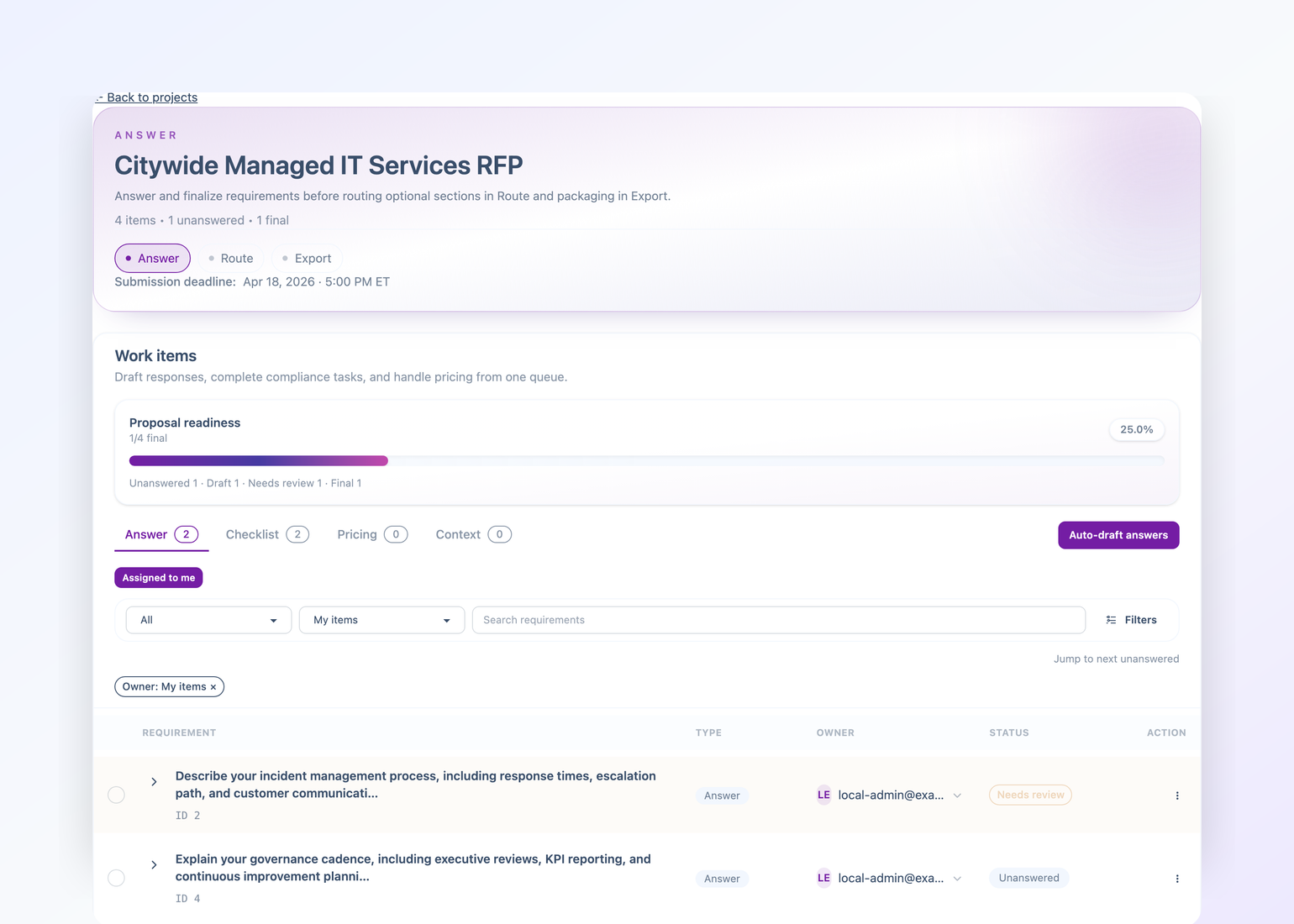
Use the template first. Then graduate from static files when the work repeats.
Start with files you can use today, then move to software when reuse and review become the bottleneck.
If you need a free RFP response template, the practical next step is usually a document you can use right now — not a thin landing page that only talks about templates.
If you want the shortest path to the download itself, use the dedicated free RFP template page. This page stays focused on the fuller walkthrough, example structure, and guidance for tailoring the template once you have the files.
The downloads on this page give small proposal teams a starting structure for organizing the response, aligning contributors, and evaluating fit. That is useful on its own, especially when you are still managing work in docs and spreadsheets.
When the same questions keep coming back, though, the real bottleneck is no longer the blank page. It is reuse, version control, review speed, and drafting from approved source material. That is where Winify AI’s RFP response software becomes the better next step.
If you are still running bids with a lean team, also see how small teams structure RFP response software workflows and compare whether a lightweight system now saves more time than another manual process.
What is a free RFP template?
A practical starting point for structuring, assigning, and reviewing a proposal response.
A free RFP template is a reusable starter document that helps a team structure its response, organize core sections, and evaluate fit before building a more repeatable proposal workflow.
People often use free RFP template to mean either a buyer-side request-for-proposal template or a seller-side response template. This page is for the response side: the document your team uses to answer an RFP clearly and consistently.
For most lean teams, a good free RFP template should include an executive summary, a requirements response table, delivery approach sections, proof/case-study placeholders, and a simple scoring matrix to support bid/no-bid and review decisions.
That is exactly what this page provides: an editable Word template, a scoring matrix, and a visible outline you can copy immediately. If your team later needs reuse, version control, and faster drafting from approved source material, move next into RFP response software.
Quick start
- Download the free files. Grab the Word template and scoring matrix so your team has a practical starting point immediately.
- Tailor the reusable structure. Keep the main sections, then swap in buyer-specific proof, delivery language, and owners for the live opportunity.
- Move repeated work into software later. When the same answers, reviews, and approvals start recurring, shift the workflow into RFP response software or the small-team workflow page.
- • Use it when you need a practical starting point fast
- • Adapt it when buyer requirements or review criteria change
- • Replace static-file chaos with software once reuse becomes the bottleneck
What should an RFP response template include?
The strongest response templates help your team answer clearly, review quickly, and reuse structure across bids.
A strong RFP response template should include the repeatable sections your team needs on almost every bid, plus enough structure to guide review and ownership.
At minimum, include an executive summary, company overview, requirements response table, delivery approach, proof points or case studies, pricing or commercial notes when relevant, and a final review checklist. If your team evaluates opportunities formally, add a simple scoring matrix so the template also supports bid/no-bid decisions.
The goal is not to create a giant generic document. The goal is to standardize the parts that repeat, while leaving clear space for buyer-specific tailoring. That keeps drafting faster without making every response sound recycled.
- • Executive summary and buyer-fit framing
- • Requirements table with owners, status, and evidence
- • Delivery approach, timeline, and governance structure
- • Proof points, case studies, and differentiators
- • Review checklist and optional scoring matrix
If those reusable sections are already spread across old docs and the real problem is assembling them fast, that is usually the point where a proposal answer library and RFP response software become more valuable than another static file.
When is a free template enough, and when do you need software?
Templates solve the blank-page problem. Software solves repeated reuse, review, and version-control pain.
A free template is enough when your team only needs a solid starting structure, handles a lower volume of bids, and can still manage drafting and review comfortably in docs and spreadsheets.
You usually need software once the same answers keep getting reused across opportunities, contributors are hunting through old files for approved language, and review cycles are slowing down because no one trusts the latest version.
That is the practical split: templates help you start faster, while software helps you respond repeatedly without rebuilding the workflow each time. For lean teams, the switch often happens when reuse and coordination become the main bottlenecks rather than document structure.
A template is usually enough when…
- • You need one practical response document quickly
- • Bid volume is still manageable manually
- • Reusable content lives in a few known places
- • Review overhead is still light
You likely need software when…
- • The same answers get rewritten across bids
- • Approved proof and content are scattered
- • Multiple reviewers create version confusion
- • Faster first drafts would materially save time
If that second column already sounds familiar, the better next step is usually to keep the template for structure and move the repeated work into Winify AI’s RFP response software.
How to create an RFP template your team can actually reuse
This directly answers the common 'how to create an RFP template' question without forcing you into software first.
If you are creating an RFP template from scratch, do not start by designing the perfect document. Start by capturing the sections your team repeats in nearly every response, then leave room for buyer-specific tailoring.
- Set the fixed structure. Include an executive summary, company overview, requirements table, delivery approach, proof or case studies, and a final review section.
- Separate reusable content from opportunity-specific content. Keep baseline company language and proof points easy to swap in, but rewrite the buyer-facing summary for each bid.
- Add scoring or review fields. Track fit, owners, deadlines, and evaluator notes so the template supports bid/no-bid decisions instead of just drafting.
- Test it on one live response. If contributors keep rewriting the same sections or hunting for approved answers, the structure is good enough to use — and you are close to needing a reusable software workflow.
If you want the shortcut instead of building from zero, download the template and scoring matrix on this page, then use how to write an RFP for buyer-side structure or move into RFP response software once repeated reuse becomes the bottleneck.
Template sections
What a strong RFP response template should already include
These sections give lean teams enough structure to answer clearly without overcomplicating the response.
Executive summary
Summarize the buyer need, your fit, and the delivery outcome you are proposing in plain language.
Company overview and differentiators
Use a short approved baseline that explains who you are, what you do well, and why your team is a credible fit.
Requirements response table
List each requirement, indicate compliance or fit, and attach the supporting narrative or proof point.
Delivery approach
Explain implementation, staffing, governance, communication rhythm, and risk management in a reusable structure.
Case studies and proof
Insert short evidence blocks that show similar work, outcomes, and context without bloating the whole proposal.
Review and scoring notes
Track bid/no-bid fit, owners, deadlines, and evaluator notes so the team can prioritize the right opportunities.
Preview the response structure before you download it
You should be able to see the outline, copy the logic, and use the page even before opening the file.
| Section | Purpose | What to include |
|---|---|---|
| Executive summary | Frame your fit quickly | Buyer need, solution angle, delivery confidence, expected outcome |
| Requirements table | Answer each requirement consistently | Requirement, response summary, supporting source, owner, status |
| Delivery approach | Show how the work will be done | Timeline, staffing, governance, milestones, review points |
| Proof and case studies | Back up claims with evidence | Relevant experience, outcomes, references, short differentiators |
Copyable example section
Executive Summary

[Buyer name] needs a partner that can respond reliably, keep stakeholders aligned, and deliver the work without creating extra process overhead. [Your company] is a strong fit because we combine [core capability] with a practical delivery approach built for [team or buyer context].

For this engagement, we would focus on:
- [Outcome 1 tied to buyer goal]
- [Outcome 2 tied to delivery reliability]
- [Outcome 3 tied to speed, quality, or risk reduction]

Our team would deliver through [implementation approach], with clear owners, regular review points, and a structure that keeps the response aligned to your stated requirements.
If your team is also trying to organize reusable source content behind these sections, pair this with the proposal content library template, read how to reuse past RFP answers, review the proposal answer library, or compare plans on the pricing page when you are ready to move beyond static files.
If your lean team is already beyond one-off documents and needs a faster repeatable workflow, explore RFP response software or see how small proposal teams organize the process.
What to customize before you send the response
A free request for proposal response template only helps if your team knows what to tailor before submission.
The fastest way to make a reusable template feel buyer-specific is to keep the structure fixed while customizing the parts evaluators actually notice. Use this checklist before you send the response.
Pre-send checklist
- Rewrite the executive summary for this buyer. Mirror the buyer goals, constraints, and delivery priorities instead of leaving a generic intro in place.
- Align each requirement to an owner and proof source. Your request for proposal response template should show who owns the answer and where the supporting evidence comes from.
- Swap in relevant proof points. Choose case studies, outcomes, and references that match the buyer context rather than reusing generic credibility blocks.
- Tailor the delivery approach. Update timeline, governance, milestones, assumptions, and communication rhythm so the response feels operationally real.
- Check the review and scoring fields. Confirm deadlines, risks, bid/no-bid fit, and evaluator notes before the draft moves to final review.
If your team keeps doing this customization manually across multiple bids, the next step is usually to move reusable source material into the proposal answer library workflow and keep the template as the response shell rather than the whole system.
For the broader operating model, compare RFP response software, the small-team workflow, and how to reuse past RFP answers after you download the files.
When to upgrade
When a template stops being enough
The blank page problem usually comes first. The reuse problem shows up right after that.
You keep rewriting the same answers
A template helps structure the response, but it does not solve content reuse across multiple bids.
Approved content is scattered everywhere
Once evidence, delivery language, and company background live across old files, drafting quality drops fast.
Reviews and handoffs slow everything down
Static docs create friction when multiple contributors need to update, review, and align around the same response.
The team needs stronger first drafts
Winify AI helps small teams upload a real RFP, reuse approved source material, and generate stronger drafts faster.
RFP Response Template FAQs
Common questions from teams looking for a practical response starting point
What is included in the download?
The page gives you a downloadable RFP response template in Word plus an Excel scoring matrix so you can start structuring both your written response and your evaluation workflow immediately.
Who is this template for?
It is built for small and lean proposal teams that need a solid starting structure for responding to an RFP without buying heavyweight enterprise tooling first.
How should I adapt the template?
Keep the section structure consistent, tailor the executive summary and differentiators to the buyer, and swap in approved proof points and delivery language that match the opportunity.
How do I create an RFP template from scratch?
Start with the core sections most teams reuse in every response: executive summary, company overview, requirements table, delivery approach, proof points, pricing or commercial notes, and a final review checklist. Then adapt the wording and evidence for each buyer instead of rebuilding the whole structure every time.
When is a template not enough anymore?
Once your team keeps reusing the same answers across many bids, chasing versions across docs, and rewriting the same sections under deadline pressure, software becomes more useful than another static file.
How does Winify AI fit after the template?
Winify AI helps small teams upload a real RFP, structure requirements quickly, reuse approved source material, and generate stronger first drafts without starting from scratch each time.
Download the template now, then build a reusable response workflow later
Use the free template and scoring matrix to get moving today. When your team needs faster drafting and approved-answer reuse, Winify AI is the next step.